
Principled Influence One-pager
ToolThird Side Strategies

Principled Influence: A Quick-Start Guide to Navigating Public Affairs in Polarized Environments

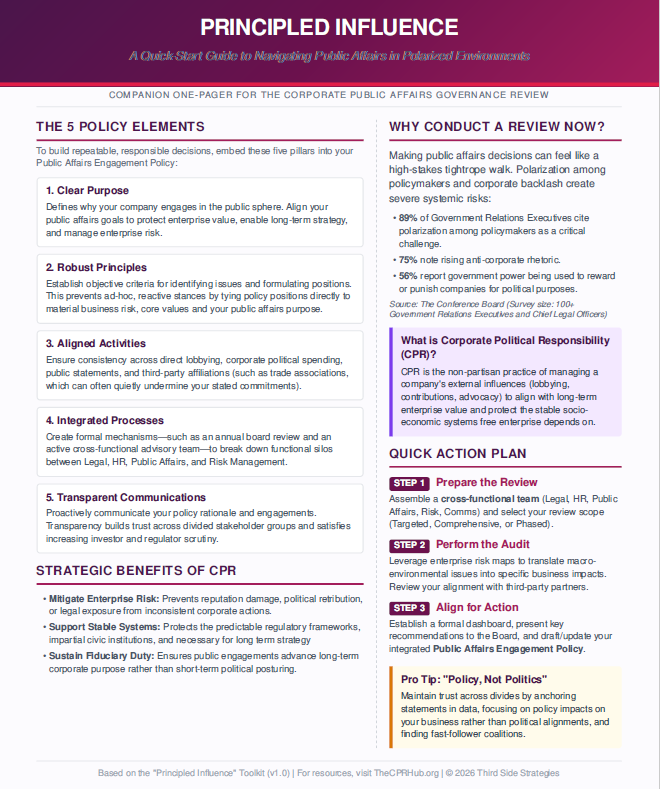
What It Is: A one-page overview of our Principled Influence guide, to help public affairs leaders prepare to conduct a Public Affairs Governance Review. Outlines five elements of an effective Public Affairs Engagement Policy, three strategic benefits and three steps to complete a tailored review.

Why It Matters: Helps companies navigate polarization, anti-corporate rhetoric, and politicized decision-making by updating their policies and practices before a crisis, establishing repeatable, responsible, defensible guidelines for managing public affairs. 

How to Use It: Scan the one-pager to assess whether a review would help safeguard your firm. Share it with colleagues to test interest, identify areas of focus and form a cross-functional review team. When ready, consult the full guide for step-by-step worksheets and tips (Principled Influence: A Guide to Strengthening Public Affairs Practices in Polarized Environments).

(With appreciation to the team at Chief Executives for Corporate Purpose for help in crafting this summary.)

More Resources

Sort by type
421 – 432 of 432 results showing
ReportUN

Widely accepted multi-sector framework outlining expectations for companies to evaluate and disclose their commitment to human rights, identify salient issues, identifying processes for responding to claims, conducting due diligence and identifying strategies to prevent, mitigate or remediate adverse impacts on individuals and communities. Supports corporate political responsibility by outlining political rights as human rights, and providing established processes to draw on. 

View Details
ReportHeritage Foundation

This article outlines how crony capitalism distorts the market, violates the principles of free markets, and risks value creation for all, as reflected in the Heritage Foundation's Index of Economic Freedom.

View Details
ReportTransparency International's Global Corruption Report

What It Is: An early analysis in Transparency International's 2009 Global Corruption Report, examining the line between legitimate corporate lobbying — an accepted input to democratic decision-making — and lobbying that captures regulations and policy for private benefit. 

Why It Matters: The report backs its argument with striking figures: politically connected firms are estimated to account for nearly 40% of market capitalization in the UK and 80% in Russia; roughly 2,500 lobbying organizations and 15,000 lobbyists compete for influence in Brussels alone; and US state-level lobbying spending averages $200,000 per legislator, with five lobbyists vying for each lawmaker's attention. Outlines the importance of considering Legitimacy of lobbying efforts, and Responsibility not to crowd out other voices." 

How to Use It: Use this chapter's distinction between legitimate lobbying and policy capture as a discussion input when running a Public Affairs Governance Review with Third Side Strategies' Principled Influence Guide — particularly Step Two's policy assessment — to help sharpen the language in your Public Affairs Engagement Policy defining where advocacy ends and undue influence begins.

View Details
ArticleSSIR

Outlines a framework to help companies determine how to engage with social issues and an appropriate level of engagement—ranging from supporter to champion—describing the key to an effective engagement plan that integrates functional silos, all bolstered by compelling case studies.

View Details

This seminal report from Freshfields Bruckhaus Deringer, addresses the question of whether institutional investors such as pension funds and insurance companies are legally permitted to integrate environmental, social and governance issues into their investment decision-making and ownership practices. The study describes the legal framework for institutions in Australia, Canada, France, Germany, Italy, Japan, Spain, the UK and the US.

View Details
ReportAccountAbility, UN Global Compact

This guide provides a framework for companies and NGO's to use to determine whether their lobbying practices are responsible.

View Details
BookBerrett Koehler

The book opens by establishing the minimum expectation that businesses support the right rules of the game—those rewarding long-term value creation rather than destruction—and shows how companies can live their values through cross-sector collaboration, eco-efficiency, and strategies advancing prosperity, planet, and people, supported by real-world cases.

View Details
BookHarvard University Press

Mancur Olson’s classic work explains why individuals often fail to organize effectively around shared interests, even when collective action would benefit all. His “free rider” problem and distinction between small and large groups reshape understanding of labor unions, corporations, and political coalitions. Olson’s framework underlies modern theories of governance, lobbying, and institutional design—key foundations for Corporate Political Responsibility. 

View Details
WebsiteBraver Angels

The Depolarization Dojo is an interactive training platform designed to help individuals practice skills for reducing political polarization and engaging constructively across disagreement. Through simulations, exercises, and dialogue-based learning, it teaches users how to de-escalate conflict, challenge assumptions, and strengthen civic trust in increasingly polarized social and organizational environments.

View Details
ArticleMIT Sloan

Presents a framework for when companies should present forceful or tempered political positions based on their publicly stated values and materiality.

View Details
Website

The Long-Term Stock Exchange (LTSE) listing standards include expectations that companies will take responsibility for long-term decision-making across strategy, governance, executive compensation, stakeholder engagement, and investor relations. These standards are designed to help businesses build sustainable value over time for all stakeholders, rather than focusing on short-term gains, allowing investors to better assess long-term capital investments.


View Details
ReportSaylor Academy

This textbook section introduces major corporate and agency public-relations subfunctions: issues management, media and community relations, CSR and philanthropy, investor relations, marketing communications, government relations, lobbying, internal communication, crisis management, and more. It shows how communication, advocacy, and stakeholder engagement are structured inside organizations, shaping how they respond to risks, opportunities, and public scrutiny.

View Details
Share.

Do you have a resource to recommend for The CPR Hub? Please reach out and we will review it for future updates!
Receive Updates from The CPR Hub

Learn about new tools, insights and events to help you consider how CPR can help your company, clients or members.

CAPTCHA
This question is for testing whether or not you are a human visitor and to prevent automated spam submissions.
Stay in the loop.