Receive Updates from The CPR Hub
Learn about new tools, insights and events to help you consider how CPR can help your company, clients or members.


What It Is: This resource comes from the Leadership Now Project, which describes itself as a nonpartisan coalition of business leaders and outlines principles that guide its positions. This particular resource is explicitly framed around how the risk environment for the 2026 midterms has shifted before, during, and after Election Day, paired with an explainer on U.S. election safeguards and a five-point action plan for business leaders.
Why It Matters: The memo grounds its case in the safeguards already in place — 96% of voters use a paper-verified ballot, 49 states conduct post-election audits, and 44 states verify mail-in ballot identity — while flagging specific new risks that could affect voter confidence and election administration this cycle.
How to Use It: The memo's five actions distill to three for most companies: engage early and directly with your state and local election officials to ask how you can help; support employee civic participation through paid time off, poll-worker programs, and internal voter education; and prepare in advance — with other business leaders — for how you'd respond if post-election disputes arise.
What It Is: The Atlantic Council's annual index ranking 171 countries on political freedom, economic freedom, and rule of law (the Freedom Index) alongside income, health, education, environment, and inclusion (the Prosperity Index), using thirty years of data from 1995 to 2025.
Why It Matters: This year's headline finding is that the rule of law itself is now eroding, not just political freedom — the global Legal Subindex has declined by over a point since 2020, with the US declining from 81.2 to 69.8 since 2014. . Notably, the data shows that rule of law correlates most sharply with prosperity. Having this concrete data can help companies weigh systemic interests more accurately in their public affairs priorities.
How to Use It: Use the interactive country-profiles rankings to view the US-specific trend line alongside markets where your company operates. against thirty years of rule-of-law, political freedom, and economic freedom data — useful for enterprise risk assessments, issue prioritization, board-level briefings on geopolitical exposure, and crisis readiness.
This report explores two potential disconnects between corporate cash flows and value creation: Positive externalities where companies are not fully rewarded for the value they create for society, and negative externalities where they do not pay the full costs of production (but "externalize" some costs to society.)
By offering a simple method for conceptualizing these two types of externalities, the authors show how businesses can be prepared for three forces that will likely drive them toward internalization: regulation, stakeholder pressures, or market realities. This can provide a guide for companies to identify their long-term interests in policies that align business value with societal value.
This commentary argues that rising authoritarianism represents a material risk to investors by undermining rule of law, regulatory stability, and democratic institutions. It explores how political systems influence capital markets and suggests investors and companies must incorporate governance and democracy risks into investment analysis.
What It Is: A policy hub, led by Director Wren Orey, working to strengthen public trust in elections and ensure secure, fully funded, and continually improved election systems,. that publishes ongoing research, testimony, and explainers on election administration, security, and reform, including advisory groups such as the Task Force on Elections and the Election Workforce Advisory Council.
Why It Matters: The project spans practical, current questions — like its recent recommendations on the EAC's 2026 Election Administration and Voting Survey — giving business leaders a running, non-partisan source on the current state and any changes in election law and administration.
How to Use It: Subscribe to BPC's Governance Policy Newsletter or bookmark the hub to track new issue briefs (e.g., the 2026 Midterms: Key Dates and Events) relevant to internal planning around election-year civic engagement.
What It Is: A curated resource page offering seven concrete strategies for building a "voter culture" at work, plus links to five vetted digital tools — including: BallotReady, Civic Alliance, Motivote, Time To Vote, and VoteAmerica — that companies can deploy to support employee voter turnout.
Why It Matters: BFA grounds its case in concrete workplace data: work commitments are consistently cited as a top barrier to voting, while "my employer" ranks among the most trusted institutions, well above government and media. That combination gives Legitimacy to employer-led civic engagement — a trusted messenger removing a documented practical barrier, rather than a company taking a political stance.
How to Use It: Pick one or two of the five listed tools: and pair with BFA's 7 strategies to build a simple internal civic engagement plan ahead of the midterms.
Businesses United in Leading Democracy is a coalition initiative encouraging companies to support democratic participation, civic trust, and institutional resilience through nonpartisan engagement. The initiative promotes collaboration among businesses committed to protecting democratic norms, strengthening civic systems, and encouraging responsible corporate leadership in periods of political polarization and democratic strain.
What It Is: A nonpartisan hub providing trusted election security resources, training, and timely updates for election officials, organized into Physical Security, Cybersecurity, and Operations resource libraries, plus services including trainings and an Insights & Events series.
Why It Matters: Election offices face novel risks this cycle — from targeted cyberattacks to physical threats against officials — and companies increasingly need both practical actions and a defensible rationale for supporting election security. This directly reflects Responsibility b) — Strong representative democracy, which calls on business to help protect "effective, transparent and accountable civic institutions" — making the Exchange's concrete, operational guidance (e.g. its recent website-security "fast wins") a template for what that support looks like in practice.
How to Use It: Companies with cybersecurity, physical-security, or crisis-communications expertise can use the Resource Library to understand what local election offices actually need and consider offering pro bono expertise or in-kind support through the Exchange's Services page.
The Equitable Bank Standards define a comprehensive framework for banks across five areas: governance, lending and investments, products and services, operational practices, and corporate citizenship. They lay out concrete standards for maximizing positive social and environmental impact while minimizing harm, guiding bankers, regulators, advocates, and customers in assessing whether finance advances equity and community well-being.
This empirical study examines how green energy investment, innovation capacity, and political stability jointly drive sustainable economic growth across OECD countries. It finds that institutional stability and governance quality significantly amplify the economic returns of environmental investment, reinforcing the link between political systems and green competitiveness.
What It Is: A 2024 EconTalk podcast conversation between host Russ Roberts and Yuval Levin (American Enterprise Institute), built around Levin's book American Covenant, arguing that the Constitution's design — competition, federalism, the Electoral College, bicameralism — is meant to let a divided society "act together" without requiring everyone to think alike.
Why It Matters: Levin's central reframe offers a broad perspective on the U.S. Constitution as incorporating dilemmas that are never fully resolved, where unity means acting together on a case-by-case basis. He argues that constitutional structures deliberately constrain majorities to protect minority interests. Useful in considering the Responsibility Principle and support for constitutional democracy.
How to Use It: Listen to or read the transcript ahead of internal conversations about polarization or civic-engagement messaging, as a values-neutral primer on why democratic institutions are structured the way they are — useful context before wading into more contested reform debates.
What It Is: A July 2026 Bipartisan Policy Center report by J.D. Rackey and Lily Kincannon, based on 12 in-depth interviews with Republican and Democratic political operatives (analyzed via qualitative coding), examining how party insiders actually view their role in primaries and which electoral reforms they believe would or wouldn't strengthen political parties.
Why It Matters: The findings are concrete and counterintuitive: every operative interviewed said party organizations exist to win elections, not to shape ideology, and most were skeptical that reforms like ranked-choice voting or nonpartisan primaries would meaningfully improve trust — favoring instead reforms that strengthen parties' own fundraising and organizing capacity. Useful in considering the Responsibility Principle and support for constitutional democracy..
How to Use It: Consider these perspectives in discussions with government-affairs or corporate PAC team about electoral-reform policy priorities or positions.
What It Is: A two-hour, multiplayer leadership simulation from Harvard Business Publishing and Forio in which teams of advisors lead a fictional country through an escalating outbreak crisis, making high-stakes ethical decisions with incomplete information and no established precedent to guide them.
Why It Matters: The simulation is built specifically to expose the gap between a team's stated values and its actual behavior under pressure — forcing profound disagreement within the team itself, not just against an external threat. That tension mirrors what many public affairs and crisis-communications teams experience when a company's stated commitments meet a fast-moving, high-stakes real-world event.
How to Use It: Use with public affairs, communications, or executive teams as a low-stakes way to pressure-test how your organization's decision-making process holds up under disagreement and incomplete information, before a real crisis puts those same dynamics to the test.
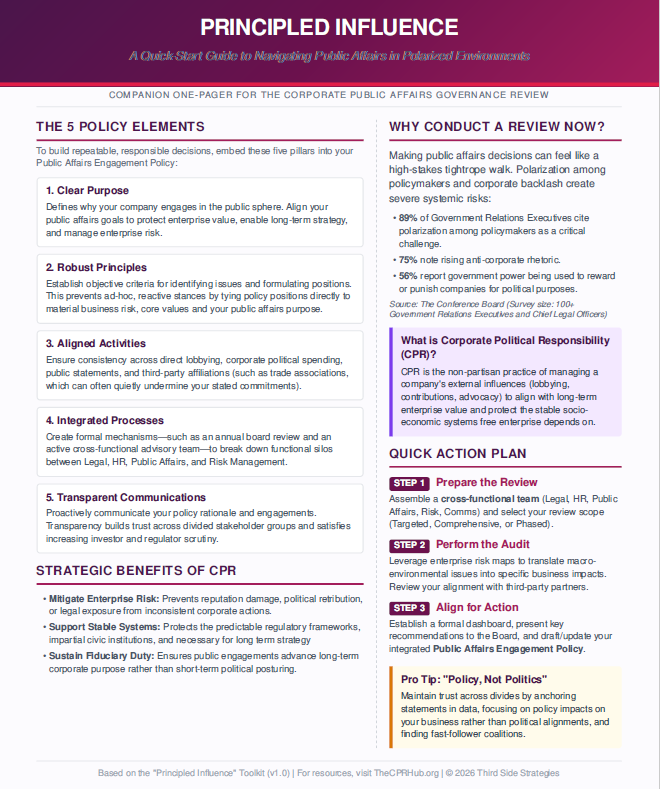
What It Is: A one-page overview of our Principled Influence guide, to help public affairs leaders prepare to conduct a Public Affairs Governance Review. Outlines five elements of an effective Public Affairs Engagement Policy, three strategic benefits and three steps to complete a tailored review.
Why It Matters: Helps companies navigate polarization, anti-corporate rhetoric, and politicized decision-making by updating their policies and practices before a crisis, establishing repeatable, responsible, defensible guidelines for managing public affairs.
How to Use It: Scan the one-pager to assess whether a review would help safeguard your firm. Share it with colleagues to test interest, identify areas of focus and form a cross-functional review team. When ready, consult the full guide for step-by-step worksheets and tips (Principled Influence: A Guide to Strengthening Public Affairs Practices in Polarized Environments).
(With appreciation to the team at Chief Executives for Corporate Purpose for help in crafting this summary.)
This report explores how geopolitical fragmentation, shifting alliances, and economic realignment are reshaping corporate sustainability strategies. It argues that companies must redesign governance structures, partnerships, and operating models to remain resilient while balancing sustainability commitments with rising political, regulatory, and market uncertainty across regions and sectors.
This report by BSR explores how a strategic context defined by fragmentation, geopolitical tension, contested information, and uneven economic and social conditions impacts companies' sustainability strategies. As climate impacts, inequality, and technological disruption accelerate, the report argues that sustainability strategies should be sharper, more resilient, and more closely tied to enterprise priorities.
The authors also argue that business plays a critical role in safeguarding the stable operating environment and bedrock institutions necessary for its success.
This article examines two methods for pricing carbon – the first based on estimating the “social cost of carbon” for current and future generations, and the second based on mandating limits and using a permit system to meet them. Argues for a fixed limit based on tipping points, and points to the challenges of political coordination required to adopt it, and the potential for technology to make that easier.
This article introduces the Erb Principles for Corporate Political Responsibility (CPR), a framework designed to help companies align political influence with long-term system health, democratic legitimacy, and responsible governance. The principles emphasize legitimacy, responsibility, accountability, and transparency as foundational standards for evaluating lobbying, political engagement, and broader public affairs practices in increasingly polarized environments.
What It Is: A 2026 book by retail futurist Doug Stephens (founder of Retail Prophet) arguing that declining institutional trust, eroding economic fairness, and a weakening education system aren't just societal problems but an untapped source of competitive advantage, laying out a step-by-step business plan for companies to invest in strengthening democracy, fair capitalism, and public education in order to set strategy for the next era of business.
Why It Matters: Stephens frames the stakes directly: "no company can thrive in a society that is failing." He argues that the postwar engines of trust, fair capitalism, and education that powered prosperity are now seizing up, and that companies which help restart them can build investor confidence, employee commitment, and customer loyalty in the process. In Chapter 30, he makes the business case for reinforcing democracy and the need for corporate political responsibility, where companies conduct themselves "in a manner that supports and reinforces the rules of play necessary for a free market.”
How to Use It: Use the book's step-by-step business plan as a starting framework for connecting your company's civic and democracy-related investments directly to competitive strategy. Refer to Chapter 30 as you craft and apply a reasonable set of rules to guide political advocacy, donations, and lobbying, to ensure you are reinforcing and strengthening the foundational systems that contribute to a healthy free-market and well-functioning democracy.
This article distinguishes between pro-market policies that enhance competition – so businesses that create value are rewarded -- and pro-business policies that favor specific businesses or industries. It argues that government favoritism distorts competition, undermines innovation, reduces opportunity and weakens democratic accountability, urging policymakers to prioritize competitive neutrality and institutional integrity over industry capture.
Why this resource matters
It reflects CPR’s Responsibility principle, calling for businesses to “champion healthy market “rules of the game” that foster competition on the basis of quality, price and long-term value, minimizing costs externalized to other stakeholders and aligning private interests with the broader public good.”
This report is based on interviews with twenty-nine partners and associates from law firms that responded to 2025-26 Executive Orders and other federal challenges with a wide variety of strategies -- from compliance to lawsuits.
The focus was on the strategic calculations driving decisions by individual lawyers and law firms, regardless of the strategy they took. The report concludes that fear significantly magnifies perceptions of risk, collective action is critical in responding to pressure, and business leaders have a crucial stake in upholding rule of law, for its own sake and as a cornerstone of the free market system.
What It Is: An article laying out a structured "nonmarket strategy" framework — analysis, strategy formulation, capacity building, feasibility checks, and implementation — for how companies should engage with regulators, activists, and public opinion alongside their core market strategy.
Why It Matters: The authors provide detailed cases that show the risks and best practices, that impact a company's social license to operate — arguing that nonmarket engagement isn't a side activity but a core determinant of whether a company's social license to operate holds.
How to Use It: Use the five-stage framework (analysis, strategy, capacity, feasibility, implementation) as a working checklist when developing or auditing your organization's own nonmarket/public affairs strategy, while also considering safeguards, such as those in our Principled Influence: A Guide to Strengthening Public Affairs Practices in Polarized Environments.
This article examines how the global rise of authoritarian capitalism is reshaping the operating environment for multinational firms. It explores tensions between economic opportunity, political stability, human rights, and democratic governance, arguing that businesses increasingly face strategic and ethical dilemmas when operating within systems where state power and market activity are tightly intertwined.
This article argues that firms are significant political as well as economic actors, with considerable power to shape the rules of the game within which they compete. Fillling in the gap in the prevailing theory of the firm, which ignores the elements of politics and power, Zingales outlines the risk of a “Medici vicious circle,” and how this risk depends on several non-market factors. He develops a framework for understanding corporate political behavior as endogenous to market systems, emphasizing how firms influence governance structures, competition, and distributional outcomes.
What It Is: The World Justice Project's annual Rule of Law Index, drawing on surveys of more than 215,000 households and 4,100 legal practitioners and scholars across 143 countries, scoring each country on eight factors — including Constraints on Government Powers, Absence of Corruption, Open Government, and Fundamental Rights — further broken into 44 sub-factors.
Why It Matters: The 2025 edition found the global rule-of-law recession accelerating, with 68% of countries declining (up from 57% the prior year). The United States ranked 27th out of 143 countries, falling in seven of eight factors for the third consecutive year and ranking among the ten countries with the largest declines worldwide.
How to Use It: Use the interactive country rankings to benchmark rule-of-law trends — and the specific factors driving them — in every market where your company operates, useful for enterprise risk assessments and board-level briefings on legal and regulatory exposure.
What It Is: An HBS Institute for Business in Global Society article profiling how companies like Levi Strauss, Salesforce, and Patagonia are supporting non-partisan voter participation while managing the risks of political backlash.
Why It Matters: The perceived legitimacy of these programs is broad: 82% of U.S. adults say companies should give employees time off to vote, and 69% say firms should actively encourage voting. That external legitimacy translates to measurable company-level impact — working at a Time to Vote member company increases an employee's likelihood of voting by 2.1 percentage points, based on a study of 30 million workers at 377,000 companies.
How to Use It: Consider your company's existing commitments to civic participation and which level of engagement fits — paid time off to vote, poll-worker support, or voter registration partnerships. Then consider how to articulate your rationale in a way that respects broad public opinion on the issue. Use the Levi Strauss, Salesforce, and Patagonia examples as models.