
Document cover
ToolThird Side Strategies

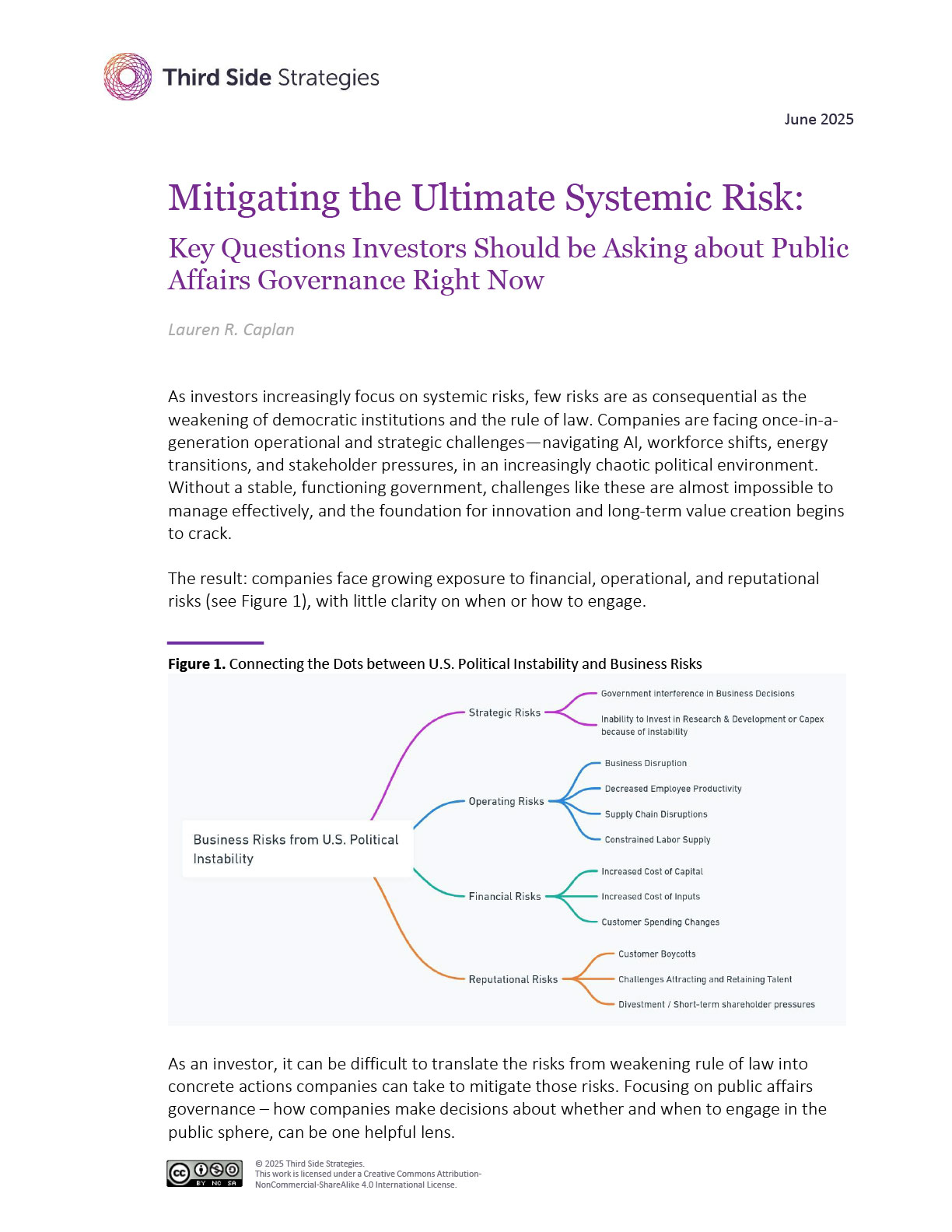
Mitigating the Ultimate Systemic Risk: Key Questions Investors Should be Asking about Public Affairs Governance Right Now

As investors increasingly focus on systemic risks, few risks are as consequential as the weakening of democratic institutions and the rule of law -- or today’s once-in-a-generation operational and strategic challenges from AI, an increasingly chaotic political environment, and more.  Yet, as an investor, it can be difficult to translate these systemic risks into concrete actions. Focusing on public affairs governance – how companies make decisions about whether and when to engage in the public sphere, can be one helpful lens.

This new tool from Third Side Strategies helps investors to ask sharper questions—of companies and of themselves. It introduces the concept of CPR Governance (a set of best practices for whether and when to engage in the public sphere) which helps investors in two ways: (i) prompting companies to think more concretely about their public affairs practices and strengthen any areas of weakness highlighted by the questions, and (ii) providing investors the information needed to more effectively manage this systemic risk across their portfolio.

More Resources

Sort by type
361 – 364 of 364 results showing
BookHarvard University Press

Mancur Olson’s classic work explains why individuals often fail to organize effectively around shared interests, even when collective action would benefit all. His “free rider” problem and distinction between small and large groups reshape understanding of labor unions, corporations, and political coalitions. Olson’s framework underlies modern theories of governance, lobbying, and institutional design—key foundations for Corporate Political Responsibility. 

View Details
ArticleMIT Sloan

Presents a framework for when companies should present forceful or tempered political positions based on their publicly stated values and materiality.

View Details
Website

The Long-Term Stock Exchange (LTSE) listing standards include expectations that companies will take responsibility for long-term decision-making across strategy, governance, executive compensation, stakeholder engagement, and investor relations. These standards are designed to help businesses build sustainable value over time for all stakeholders, rather than focusing on short-term gains, allowing investors to better assess long-term capital investments.


View Details
ReportSaylor Academy

This textbook section introduces major corporate and agency public-relations subfunctions: issues management, media and community relations, CSR and philanthropy, investor relations, marketing communications, government relations, lobbying, internal communication, crisis management, and more. It shows how communication, advocacy, and stakeholder engagement are structured inside organizations, shaping how they respond to risks, opportunities, and public scrutiny.

View Details
Share.

Do you have a resource to recommend for The CPR Hub? Please reach out and we will review it for future updates!
Receive Updates from The CPR Hub

Learn about new tools, insights and events to help you consider how CPR can help your company, clients or members.

Stay in the loop.