
ReportEuropean Financial Reporting Advisory Group (EFRAG)

Draft European Sustainability Reporting Standards – ESRS G1: Business Conduct

ESRS G1 sets mandatory disclosure requirements on business conduct, covering corporate culture, supplier relationships, anti-corruption and bribery, whistleblower protection, political influence and lobbying, and payment practices, especially toward SMEs. It links governance and conduct to impact, risk, and opportunity management, making companies explain how business behavior supports transparent, sustainable practices for all stakeholders. 

Notes on Related Topics

Legal Risk or Uncertainty (A) – ESRS G1 clarifies new disclosure expectations under the EU’s sustainability reporting framework, exposing companies to regulatory and enforcement risk if they under-report or mis-report business conduct, corruption incidents, or political activity. 

Reputational Risks (A) – Required disclosures on corruption cases, whistleblower protections, and payment practices make opaque or irresponsible conduct visible to investors, media, and civil society, increasing reputation stakes for boards and executives. 

Reporting Disclosures (B) – The standard details specific narratives and metrics companies must publish on corporate culture, investigations, political contributions, and lobbying topics, embedding business conduct into core sustainability statements. 

Lobbying Policy Influence (B) – G1-5 compels disclosure of political influence and lobbying activities, including topics, positions, and financial or in-kind contributions, directly aligning public-policy engagement with material impacts, risks, and opportunities. 

More Resources

Sort by type
281 – 300 of 364 results showing
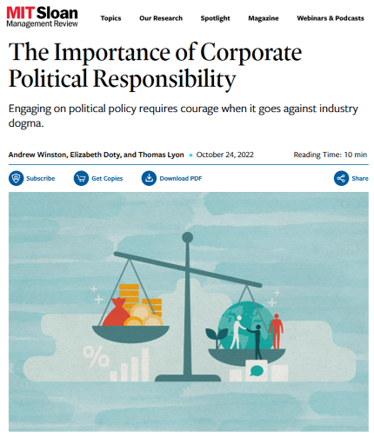
VideoCorporate Political Responsibility Taskforce
Video Details
ArticleHarvard Business Review

This article urges companies to actively reduce the polarization that can impact their businesses, by carefully considering their public stances, promoting inclusivity, and fostering collaboration across differing viewpoints within their organizations and communities.

View Details
VideoCorporate Political Responsibility Taskforce
Video Details
VideoCorporate Political Responsibility Taskforce
Video Details
VideoCorporate Political Responsibility Taskforce
Video Details
VideoCorporate Political Responsibility Taskforce
Video Details
ArticleForbes

This article argues that Modern Portfolio Theory falls short in today’s interconnected and complex risk landscape, calling for “system-level investing” that integrates social, environmental, and economic factors to boost long-term resilience and sustainability.

View Details
BookHarvard Business Review Press

Introduces the concept of “net positive advocacy,” which involves working with partners to advocate for policy that supports systemic solutions and net positive outcomes for all competitors. This requires courage and a shift in mindset, but actually helps de-risk both sustainable business strategies AND political interactions for companies. Their Readiness Test tool provides a useful conversation starter about the change in mindset required.  

View Details
VideoCorporate Political Responsibility Taskforce
Video Details
BookRealClear Publishing

This book shares the results of Diane Hessan's weekly interviews with 500 voters from every state, of every age and ethnicity, and along different points of the political spectrum. The topics ranged from race to guns, from character to party politics, from masks to rallies, from the Supreme Court to the pandemic to immigration and climate change. She finds that Americans have more common ground than they realize, but that they need new approaches to listening and understanding each other.

View Details
VideoCorporate Political Responsibility Taskforce
Video Details
VideoCorporate Political Responsibility Taskforce
Video Details
VideoCorporate Political Responsibility Taskforce
Video Details
VideoCorporate Political Responsibility Taskforce
Video Details
VideoCorporate Political Responsibility Taskforce
Video Details
ReportWorld Resources Institute

As companies face increased pressure to advocate publicly for robust climate policies, this WRI report outlines three internal and four external barriers, including org charts and quarterly reports as well as trade associations and political winds, that present the biggest hurdles to implementation, and suggests ways to overcome them.

View Details
WebsiteWorld Benchmarking Alliance

This framework is developed through a multi-stakeholder process and designed to gauge company progress against the UN Sustainable Development Goals. It provides succinct definitions for various core social indicators (CSIs), as well as a rubric to gauge company performance regarding these indicators. CSI 18 is their standard for responsible lobbying and political engagement, drawing from the Transparency International principles.

View Details
VideoCorporate Political Responsibility Taskforce
Video Details
VideoCorporate Political Responsibility Taskforce
Video Details
ArticleHarvard Business Review

This article introduces the concept of “net positive advocacy,” which involves working with partners to advocate for policy that supports systemic solutions and net positive outcomes for all competitors. This requires courage and a shift in mindset, but actually helps de-risk both sustainable business strategies AND political interactions for companies. Their Readiness Test tool provides a useful conversation starter about the change in mindset required. 

View Details
Share.

Do you have a resource to recommend for The CPR Hub? Please reach out and we will review it for future updates!

Receive Updates from The CPR Hub

Learn about new tools, insights and events to help you consider how CPR can help your company, clients or members.

Stay in the loop.