
ReportBCG

The CEO’s Case for Local Civic Engagement

What It Is: A 2026 BCG article, based on interviews with over 35 CEOs, senior executives, and community leaders, mapping a five-level spectrum of local civic engagement — from initial policies like volunteer time off to full civic leadership — and outlining five steps for CEOs to structure it as a source of competitive advantage rather than discretionary giving. 

Why It Matters: BCG's Trust Index research shows the most trusted companies generate roughly 2.5 times more value creation than market-average firms — and in the current environment of distrust, companies that show up for their local communities build exactly that kind of credibility. The case is concrete: Michelin's partnership with 50+ organizations transformed a shuttered factory site in Clermont-Ferrand into a €300 million innovation district, while Shipt's LadderUp Accelerator has awarded $1.3 million in grants enabling 2.3 million meals for food-insecure families. 

How to Use It: BCG's five steps for effective civic engagement distill to three: pick a specific, sustained focus area rather than spreading effort thin; contribute expertise and ecosystem relationships, not just funding; and build governance and measurement into the effort from the start so it survives leadership changes and budget cycles. Use our Principled Influence Guide when formalizing civic engagement to ensure it is consistent with your Public Affairs Purposes and Priorities for . 

More Resources

Sort by type
21 – 40 of 430 results showing
ReportBipartisan Policy Center

What It Is: A July 2026 Bipartisan Policy Center report by J.D. Rackey and Lily Kincannon, based on 12 in-depth interviews with Republican and Democratic political operatives (analyzed via qualitative coding), examining how party insiders actually view their role in primaries and which electoral reforms they believe would or wouldn't strengthen political parties. 

Why It Matters: The findings are concrete and counterintuitive: every operative interviewed said party organizations exist to win elections, not to shape ideology, and most were skeptical that reforms like ranked-choice voting or nonpartisan primaries would meaningfully improve trust — favoring instead reforms that strengthen parties' own fundraising and organizing capacity. Useful in considering the Responsibility Principle and support for constitutional democracy.. 

How to Use It: Consider these perspectives in discussions with government-affairs or corporate PAC team about electoral-reform policy priorities or positions. 

View Details
ReportBipartisan Policy Center

What It Is: A July 2026 Bipartisan Policy Center report by J.D. Rackey and Lily Kincannon, based on 12 in-depth interviews with Republican and Democratic political operatives (analyzed via qualitative coding), examining how party insiders actually view their role in primaries and which electoral reforms they believe would or wouldn't strengthen political parties. 

Why It Matters: The findings are concrete and counterintuitive: every operative interviewed said party organizations exist to win elections, not to shape ideology, and most were skeptical that reforms like ranked-choice voting or nonpartisan primaries would meaningfully improve trust — favoring instead reforms that strengthen parties' own fundraising and organizing capacity. Useful in considering the Responsibility Principle and support for constitutional democracy.. 

How to Use It: Consider these perspectives in discussions with government-affairs or corporate PAC team about electoral-reform policy priorities or positions. 

View Details
ArticleJournal of Consumer Marketing

This study analyzes how corporate political advocacy influences online consumer behavior and user-generated content. It examines how political positioning by brands shapes engagement, sentiment, and digital discourse, highlighting the reputational and relational consequences of corporate participation in contentious public issues. 

View Details
ToolThird Side Strategies

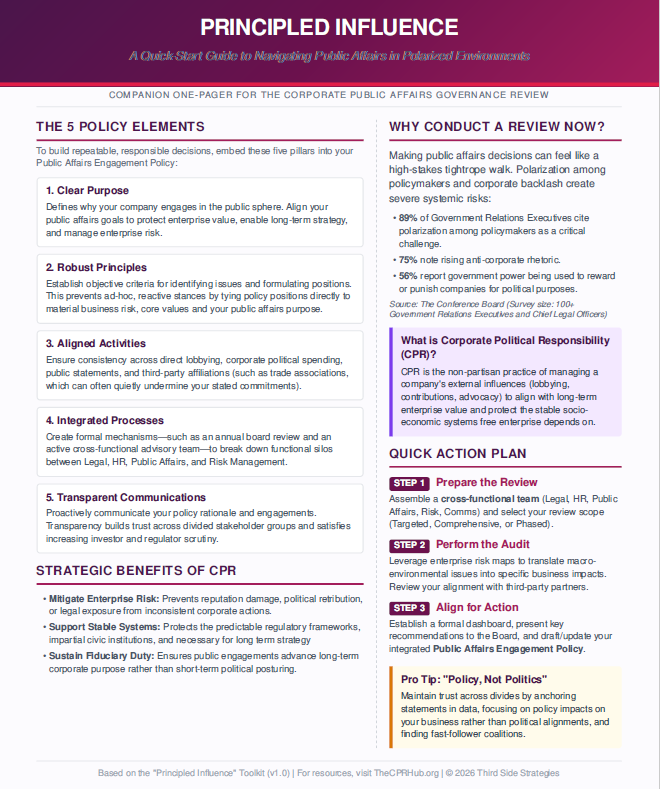
What It Is: A companion one-page quick-start guide to Third Side Strategies' Principled Influence Toolkit, distilling the five policy elements of a responsible Public Affairs Engagement Policy — Clear Purpose, Robust Principles, Aligned Activities, Integrated Processes, and Transparent Communications — into a single at-a-glance reference. 

Why It Matters: This addresses three concrete pain points Government Relations leaders report today: intensifying policymaker polarization, rising anti-corporate rhetoric, and government power being wielded to reward or punish companies politically. The case for action is stark: 89% of Government Relations Executives cite polarization among policymakers as a critical challenge, 75% note rising anti-corporate rhetoric, and 56% report government power being used to reward or punish companies for political purposes. 

How to Use It: Follow the three-step action plan to kick off a governance review: assemble a cross-functional team and set your review scope; audit your current alignment using enterprise risk maps and third-party partnerships; and align for action by building a dashboard, briefing the board, and drafting your Public Affairs Engagement Policy. Keep the "Policy, Not Politics" principle at the center — anchor statements in data and business impact, not political alignment. 

View Details

What It Is: A one-page overview of our Principled Influence guide, to help public affairs leaders prepare to conduct a Public Affairs Governance Review. Outlines five elements of an effective Public Affairs Engagement Policy, three strategic benefits and three steps to complete a tailored review.

Why It Matters: Helps companies navigate polarization, anti-corporate rhetoric, and politicized decision-making by updating their policies and practices before a crisis, establishing repeatable, responsible, defensible guidelines for managing public affairs. 

How to Use It: Scan the one-pager to assess whether a review would help safeguard your firm. Share it with colleagues to test interest, identify areas of focus and form a cross-functional review team. When ready, consult the full guide for step-by-step worksheets and tips (Principled Influence: A Guide to Strengthening Public Affairs Practices in Polarized Environments).

(With appreciation to the team at Chief Executives for Corporate Purpose for help in crafting this summary.)

View Details
ArticleBusiness for Social Responsibility (BSR)

This report by BSR explores how a strategic context defined by fragmentation, geopolitical tension, contested information, and uneven economic and social conditions impacts companies' sustainability strategies. As climate impacts, inequality, and technological disruption accelerate, the report argues that sustainability strategies should be sharper, more resilient, and more closely tied to enterprise priorities. 

The authors also argue that business plays a critical role in safeguarding the stable operating environment and bedrock institutions necessary for its success.

View Details
ArticleYankelovich Center for Social Science Research

What It Is: A research initiative from UC San Diego's Yankelovich Center, run with MIT's Election Data Science Lab and Johns Hopkins' SNF Agora Institute, testing which communication strategies actually build voter trust in elections and publishing both peer-reviewed studies and short practitioner briefs. 

Why It Matters: Offers concrete, usable findings — such as the value of state-produced informational videos that increase trust in that state's own election process, and the power of advanced messages to give voters accurate information about election processes to avoid unnecessary distrust (referred to as “pre-bunking”).  

How to Use It: Review and select specific briefs to inform how your organization communicates with employees about election timelines and results. 

View Details
ReportAmerican Immigration Council

This handbook provides practical guidance for fostering belonging, inclusion, and social cohesion across communities and institutions. It explores how organizations can strengthen trust, civic participation, and cross-cultural understanding while addressing polarization, exclusion, and identity-based division in increasingly diverse societies.

View Details
ReportBCG

What It Is: A 2026 BCG article, based on interviews with over 35 CEOs, senior executives, and community leaders, mapping a five-level spectrum of local civic engagement — from initial policies like volunteer time off to full civic leadership — and outlining five steps for CEOs to structure it as a source of competitive advantage rather than discretionary giving. 

Why It Matters: BCG's Trust Index research shows the most trusted companies generate roughly 2.5 times more value creation than market-average firms — and in the current environment of distrust, companies that show up for their local communities build exactly that kind of credibility. The case is concrete: Michelin's partnership with 50+ organizations transformed a shuttered factory site in Clermont-Ferrand into a €300 million innovation district, while Shipt's LadderUp Accelerator has awarded $1.3 million in grants enabling 2.3 million meals for food-insecure families. 

How to Use It: BCG's five steps for effective civic engagement distill to three: pick a specific, sustained focus area rather than spreading effort thin; contribute expertise and ecosystem relationships, not just funding; and build governance and measurement into the effort from the start so it survives leadership changes and budget cycles. Use our Principled Influence Guide when formalizing civic engagement to ensure it is consistent with your Public Affairs Purposes and Priorities for . 

View Details
ReportSustainable Brands

What It Is: A 2026 research study led by former Chief Sustainability Officer at Kenvue, with prior CSO roles at Mattel and L'Oréal — produced with Sustainable Brands, examining how the Chief Sustainability Officer role is evolving into a strategic enterprise leadership position spanning risk, financial performance, and value creation. 

Why It Matters: Argues that the CSO mandate is "expanding faster than the systems designed to support it," now touching purpose, stakeholders, regulation, and geopolitics rather than environmental performance alone. Accountability requires CSO's to both invest in critical knowledge and competencies and elevate attention when the role cannot keep pace with expectations.  

How to Use It: Useful for benchmarking whether your own sustainability or CPR function has the internal authority, reporting lines, and cross-functional integration that this expanded mandate requires — worth revisiting once the full findings are available. 

View Details
BookWiley

What It Is: A 2026 book by retail futurist Doug Stephens (founder of Retail Prophet) arguing that declining institutional trust, eroding economic fairness, and a weakening education system aren't just societal problems but an untapped source of competitive advantage, laying out a step-by-step business plan for companies to invest in strengthening democracy, fair capitalism, and public education in order to set strategy for the next era of business. 

Why It Matters: Stephens frames the stakes directly: "no company can thrive in a society that is failing." He argues that the postwar engines of trust, fair capitalism, and education that powered prosperity are now seizing up, and that companies which help restart them can build investor confidence, employee commitment, and customer loyalty in the process. In Chapter 30, he makes the business case for reinforcing democracy and the need for corporate political responsibility, where companies conduct themselves "in a manner that supports and reinforces the rules of play necessary for a free market.” 

How to Use It: Use the book's step-by-step business plan as a starting framework for connecting your company's civic and democracy-related investments directly to competitive strategy. Refer to Chapter 30 as you craft and apply a reasonable set of rules to guide political advocacy, donations, and lobbying, to ensure you are reinforcing and strengthening the foundational systems that contribute to a healthy free-market and well-functioning democracy. 

View Details
Report

This report is based on interviews with twenty-nine partners and associates from law firms that responded to 2025-26 Executive Orders and other federal challenges with a wide variety of strategies -- from compliance to lawsuits.  

The focus was on the strategic calculations driving decisions by individual lawyers and law firms, regardless of the strategy they took. The report concludes that fear significantly magnifies perceptions of risk, collective action is critical in responding to pressure, and business leaders have a crucial stake in upholding rule of law, for its own sake and as a cornerstone of the free market system.

View Details
ArticleCenter for Political Accountability

What It Is: A June 2026 Directors & Boards article documenting how corporate political spending oversight has shifted from a government-relations function to a board-level governance priority, citing the CPA-Zicklin Index's tracking of disclosure and accountability practices at major public companies. 

Why It Matters: Companies rated "trendsetters" for political spending disclosure and board oversight grew from 28 to 112 over the past decade — a 400% increase — reflecting a shift toward Accountability and Transparency achieved through "private ordering" (companies self-regulating) rather than government mandate. 

How to Use It: Use this to benchmark your company's political spending policy against the CPA-Zicklin Index and more recent Framework, and to make the case to your board that comprehensive oversight is now mainstream practice. 

View Details
Article Harvard Law School Forum on Corporate Governance

What It Is:  A short summary of Roe’s 2026 University of Pennsylvania Law Review article that analyzes why driving corporate social responsibility through large institutional investors with market-wide exposure to risks and opportunities was politically and legally unrealistic. 

Why It Matters: Argues that the same political forces and voter sentiment that have historically blocked direct government action on issues such as climate also mobilized against private sector action once prominent. In particular, shows how acting on Responsibility requires a clear, defensible basis in Legitimacy.  

How to Use It: Investors, business leaders and associations can use this article to make more accurate assessments of political opposition to CSR, and to develop more realistic responses and strategies. Roe suggests engaging political barriers more directly. 

View Details
ArticleHarvard Law School Forum on Corporate Governance

What It Is:  A short summary of Roe’s 2026 University of Pennsylvania Law Review article that analyzes why driving corporate social responsibility through large institutional investors with market-wide exposure to risks and opportunities was politically and legally unrealistic. 

Why It Matters:  Argues that the same political forces and voter sentiment that have historically blocked direct government action on issues such as climate also mobilized against private sector action once prominent. In particular, shows how acting on Responsibility requires a clear, defensible basis in Legitimacy.  

How to Use It: Investors, business leaders and associations can use this article to make more accurate assessments of political opposition to CSR, and to develop more realistic responses and strategies. Roe suggests engaging political barriers more directly. 

View Details
ArticleHarvard Business School Institute for Business in Global Society (BiGS)

What It Is: An HBS Institute for Business in Global Society article profiling how companies like Levi Strauss, Salesforce, and Patagonia are supporting non-partisan voter participation while managing the risks of political backlash. 

Why It Matters: The perceived legitimacy of these programs is broad: 82% of U.S. adults say companies should give employees time off to vote, and 69% say firms should actively encourage voting. That external legitimacy translates to measurable company-level impact — working at a Time to Vote member company increases an employee's likelihood of voting by 2.1 percentage points, based on a study of 30 million workers at 377,000 companies. 

How to Use It: Consider your company's existing commitments to civic participation and which level of engagement fits — paid time off to vote, poll-worker support, or voter registration partnerships. Then consider how to articulate your rationale in a way that respects broad public opinion on the issue. Use the Levi Strauss, Salesforce, and Patagonia examples as models. 

View Details
ReportEdelman

This report reveals a decline in trust, and how majorities now hold grievances against governments, business and the rich. Historically strong trust in “my employer” is complicated when employees hold grievances.  Argues that business should respond in concert with other actors, investing in local communities, quality information, and job skills.    

View Details
ArticleProMarket (Stigler Center, University of Chicago Booth School of Business)

This article argues anthropogenic emissions are driven by customer preferences and that such preferences can shift with improved information, Karthik Ramanna advocates for a new approach: an economy-wide system of reliable and comparable accounts of the embedded emissions in products to allow customers (and investors) to make better-informed decisions aligned with underlying preferences.   

View Details
ArticleProMarket (Stigler Center, University of Chicago Booth School of Business)

Part II extends the pro-market argument, outlining a global accounting standard that would embed decarbonization throughout the economy, while remaining technological neutral about how emissions are reduced. It examiniescurrent politicies and reporting standards intended to advance emissions and challenges their top-down approach as contributing to ideological stalemate, proposing that a product-level accounting system could address this barrier.  

View Details
WebsiteUS White House

The White House AI portal lays out a a multi-pronged national strategy to boost U.S. leadership in AI by investing in research, encouraging adoption across industries, and preparing the workforce for AI-driven changes. It highlights a commitment to developing AI responsibly by setting ethical guidelines, ensuring transparency and privacy, and fostering cooperation across government agencies to address risks and build public trust.

View Details
Share.

Do you have a resource to recommend for The CPR Hub? Please reach out and we will review it for future updates!

Receive Updates from The CPR Hub

Learn about new tools, insights and events to help you consider how CPR can help your company, clients or members.

CAPTCHA
This question is for testing whether or not you are a human visitor and to prevent automated spam submissions.
Stay in the loop.